

Persuasion has a branding problem. Say the word out loud and most people picture a slick salesperson, a pushy negotiator, or a debate opponent circling in for the win. Joshua Bandoch, TED speaker and author of How to Get What You Want, has spent his career dismantling that image, and honestly, it needed dismantling.
Meet Joshua Bandoch

Joshua Bandoch is a TED speaker, author, and persuasion expert whose career has taken him through academia, professional fundraising, public policy advocacy, and speechwriting for senior government officials. That range of experience isn’t just an interesting resume. It’s the reason his approach to persuasion feels so grounded. Josh hasn’t just studied influence from behind a lectern. He’s tested it in classrooms, in donor meetings, in policy negotiations, and in some of the highest-stakes conversations of his career.
Over the past decade, Josh has focused his research on a single question: what actually makes people say yes, and why do so many smart, capable professionals struggle to get there? To answer it, he’s pulled from psychology, neuroscience, economics, public policy, and history, building a framework that goes far beyond the recycled sales tactics most of us have already tried and abandoned.
That research became his TEDx Talk, How to Be More Persuasive, and later, his book, How to Get What You Want: Mastering the Art and Science of Persuasion. Josh is based in Arlington, Virginia, and continues to help executives, teams, and organizations rethink how they communicate, negotiate, and lead.
Suffice it to say, when Josh talks about persuasion, he’s not offering theory. He’s offering a framework earned through real rooms, real stakes, and real results.
Featured Book: How to Get What You Want
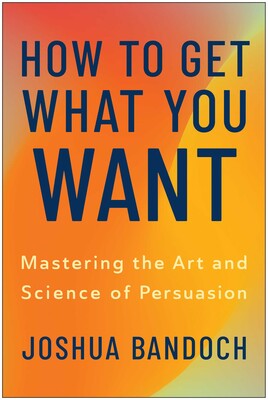
Everything Josh shared in this conversation is explored in far greater depth in his book, How to Get What You Want: Mastering the Art and Science of Persuasion.
The book expands on the ideas from his TEDx Talk, walking readers through all five aspects of our cognitive wiring that shape how persuasion actually works. It’s packed with the neuroscience behind why we feel before we reason, real negotiation stories pulled from Josh’s own career, and the exact language you can use to navigate sales conversations, leadership moments, and everyday interactions with more intention.
From Academia to the TEDx Stage
Josh Bandoch’s path to becoming a persuasion expert wasn’t exactly a straight line. He’s worked in academia, spent time as a fundraiser (which, as he puts it, is really just sales with a mission attached), served as a public policy advocate, and written speeches for people whose words needed to move rooms. Along the way, he noticed a pattern that bothered him: brilliant people, people with great ideas and real expertise, kept hitting an invisible ceiling. Not because their thinking was flawed, but because they never learned how to bring anyone else along with them.
That observation became the foundation of his TEDx Talk and, later, his book. And when he sat down for this conversation, he didn’t just explain a theory. He unpacked the actual mechanics of why persuasion works the way it does, and what most of us get backwards.
Why Smart People Struggle to Persuade
Here’s the twist Josh points to right away: the qualities that make someone impressive on paper are often the same qualities that quietly sabotage their ability to persuade.
Confidence. Sharp logic. A well-organized argument. These feel like assets, and in most areas of life, they are. But according to Josh, they can actually work against you the moment you’re trying to get another human being to say yes.
Why? Because of how our brains are built. Josh breaks this down using research into what he calls our cognitive wiring, and one piece in particular reshapes how you should think about every pitch, proposal, or team update you’ve ever given:
- We feel first, and reason second. Every time.
- Sometimes we feel, then reason. Sometimes we just feel and never make it to reasoning at all.
- Logic-first communication, no matter how airtight, is fighting against the grain of how people actually process information.
Josh even shared a fascinating detail from the research: people who lose the ability to emote due to brain injury don’t become better reasoners. Their reasoning actually gets worse. Emotion isn’t the enemy of good decision-making. It’s a core ingredient of it.
This is why a flawless, data-backed presentation can still land flat. The audience’s brain hasn’t been given anything to feel before it’s asked to agree. Josh’s advice is refreshingly simple: stop leading with the argument and start leading with the feeling.
The Real Definition of Persuasion Most Leaders Get Wrong
Ask around, and most people define persuasion as convincing someone to think the way you do. Josh takes this apart almost immediately, and it’s one of the more memorable moments in the conversation.
He points out that the word “convince” comes from a Latin root meaning to vanquish or conquer. And conquest, as he puts it, is barbaric. It’s not persuasive at all.
There’s also a simpler problem with trying to get someone to think exactly like you: nobody thinks exactly like anybody, including themselves. Josh jokes that he doesn’t even agree with everything he believed yesterday. So expecting someone else to fully mirror your thinking was never a realistic goal to begin with.
Instead, Josh defines persuasion as shared action. Two words, but they carry the whole framework:
- Shared because it has to be voluntary. Nobody is persuaded into something. They’re persuaded toward it, together.
- Action because persuasion isn’t about sounding impressive. It’s about actually getting something done, together.
He also draws a clean line between persuasion and manipulation, and it comes down to intention. Using a Star Wars comparison that lands perfectly, Josh asks: do you want to be Yoda, or the Emperor? Manipulation might get short-term results, but people eventually notice, and once they do, they don’t come back.
Action Steps
If you want to put this into practice immediately, here are three simple ways to start:
- Catch yourself in the moment. In your very next conversation, notice the instant you step into one of the three corners — the script, the surroundings, or the score. Just notice it. Don’t judge yourself for it; awareness is the entire first step.
- Swap one question for an observation. Today, replace just one script or surroundings question with a specific, genuine observation about the actual person standing in front of you — not the weather, not the room, but them.
- Practice the “double click.” The next time someone gives you a surface-level answer in one of these three corners, resist the urge to move on to a new topic. Instead, go deeper into that same thread. Research says they’ll follow you there.
Ask yourself, before your next meeting, call, or handshake: which corner do I default to most often? And what would it look like to make one different move instead? often enough that it becomes second nature which is exactly the discipline J.R. has spent his career studying and teaching leaders to build.
The Overlooked Skill Behind Every Great Negotiator
If there’s one idea from this conversation worth writing on a sticky note and putting on your monitor, it’s this one: the person doing the talking is not the one in control. The person doing the listening is.
Josh explains that when someone is talking, especially early in a conversation, they’re handing over valuable information about their needs, priorities, and hesitations, whether they realize it or not. The listener’s job isn’t to wait for their turn to speak. It’s to actually absorb what’s being offered.
He illustrated this with a story from one of the most important negotiations of his career. Instead of opening with what he wanted, he asked the other party a simple but powerful question: would you mind telling me your priorities first? The result wasn’t just a good deal. It ended up being better than his original best-case scenario, because he understood exactly what mattered most to the other side before he made a single ask of his own.
Josh also shared a lighter but equally telling story about an intern named John, a sharp, talented young professional who assumed the way to prove his value was to talk the loudest, interrupt often, and make sure everyone noticed how smart he was. It didn’t work. Once John shifted to a “team first” mindset, listening more and speaking less, he didn’t just improve. He outperformed the other interns and earned a promotion.
A few practical tools Josh recommends for putting this into practice:
- Ask how someone feels, not just what they think. It’s a small shift in language that lowers defenses and produces a more honest, reasoned response.
- Notice whether someone is leaning positive or negative, and address it directly instead of pushing past it.
- Resist the urge to assume you already know the objection. Ask clarifying questions instead of guessing.
- Let people overshare. Even in a tense or “hot” conversation, giving someone room to talk often hands you everything you need to find common ground.
Leading With Vision, Not Just Logic
Persuasion, Josh explains, doesn’t only happen one-on-one. It’s also what separates leaders who are simply respected from leaders people genuinely want to follow.
He points to figures like JFK, Martin Luther King Jr., and Ronald Reagan as examples of what he calls persuasive leadership done right. What did they have in common? They were relentlessly positive, and they were clear about what they stood for.
This matters because of something called negativity bias, which Josh describes as being wired into all of us. Bad news grabs attention faster than good news does. It’s why headlines lean dramatic and why it’s tempting for leaders to open every conversation with what’s wrong.
But according to Josh, the leaders who truly move people do the opposite. They name what they’re for before they get into what’s broken. They give people a North Star, not just a list of problems.
He also emphasizes that we’re wired for story. Facts inform people. Stories move them. Josh suggests that leaders who want to build real buy-in should:
- State the vision before diving into the problem.
- Use real stories, especially stories that highlight a team member’s contribution, to reinforce that vision.
- Pair humility with leadership. Acknowledging your own missteps, Josh notes, is far more persuasive than pretending you don’t make them.
Where Real Influence Actually Begins
What makes this conversation with Josh Bandoch so valuable isn’t a single tactic or clever line, although there are plenty of those throughout. It’s the underlying shift in mindset he offers: persuasion isn’t something you do to people. It’s something you build with them.
Josh’s research, drawn from neuroscience, psychology, and years of real-world experience across academia, fundraising, and public policy, points to the same conclusion again and again. The professionals who influence people most effectively aren’t the ones with the sharpest arguments. They’re the ones who understand what the other person is feeling before they ever try to change what they’re thinking.
Whether you’re leading a team, closing a deal, navigating a difficult customer conversation, or simply trying to be heard by the people who matter most to you, Josh’s framework offers something genuinely useful: a way to stop competing for airtime and start building something real.
Action Items
Josh’s framework isn’t meant to stay theoretical. Here are three ways to put it to work starting with your very next conversation:
- Ask the feelings question. In your next conversation that matters, swap “what do you think?” for “how do you feel about this?” Watch how quickly the other person’s guard comes down, and how much more honest their answer becomes.
- Name what you’re for before you name what’s wrong. Before you raise a problem with your team, state the positive vision it serves first. Lead with the North Star, not the complaint.
- Let them list their priorities first. In your next negotiation or pitch, ask the other person to lay out what matters most to them before you share your own agenda. Let them talk first, then respond.
Small shifts, but as Josh’s own negotiation story proves, they can be the difference between a good outcome and one that exceeds your best-case scenario.
Want This Framework in Your Back Pocket?
Want to put Josh Bandoch’s framework to work without waiting for your next big meeting? Grab the free companion cheat sheet built for this episode. Inside, you’ll find the golden rule behind why “me-first” wiring quietly kills persuasion, the Ask-Don’t-Tell technique for disarming any conversation before it starts, the Negativity Flip persuasive leaders use to earn people’s trust, and the three action items above, ready to put into practice today.