
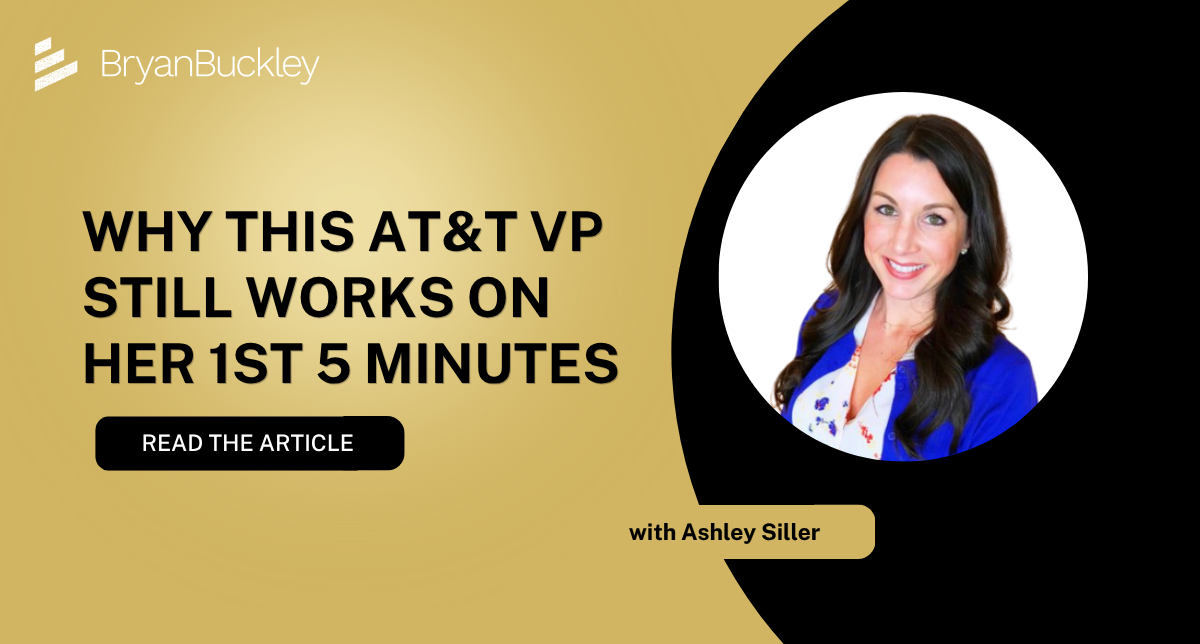
Some of the most revealing conversations do not happen in polished conference rooms or formal one-on-ones. They happen over dinner, two hours in, when people stop performing and start being real.
That is exactly where I first got to see Ashley Siller in her element. Not pitching. Not positioning. Not leading with her title. Just sitting across from me at a restaurant, asking genuine questions, leaning in, and actually listening to the answers. It was one of those moments where you see someone’s character before you fully know their résumé, and what I saw was impressive.
Ashley is an Area Vice President at AT&T, leading teams across multiple states for one of the largest companies in the world. She is a Diamond Club winner, a seasoned road warrior who has spent years crisscrossing the country for client meetings, partner events, and team engagements. By any professional measure, she has earned her seat at the table many times over.
And yet she still works on her 1st 5 minutes.
That says everything. In this conversation, Ashley and I go deep on the habits, mindset shifts, and hard-won skills that have shaped how she connects with people at every level. Whether you are a frontline seller grinding through your pipeline or a senior executive leading an organization, the principles we unpack here are both practical and immediately applicable. This is not theory. This is what elite connection actually looks like in the real world.
The Leader Who Still Wanted to Get Better
Here is something you genuinely do not hear enough from people at Ashley’s level: a high-performing executive openly admitting she had a problem and deciding to do something about it.
Despite her track record and seniority, Ashley recognized a pattern that was quietly limiting her. She is constantly on the move, cycling through sellers, partners, vendors, customers, town halls, and back-to-back meetings across multiple markets. The pace is relentless. And somewhere in the blur of all that activity, she found herself:
- Having the same conversations with people she had already met
- Unable to recall meaningful details from previous interactions
- Moving too fast to be genuinely present with the people in front of her
- Defaulting to surface-level exchanges when she actually wanted real connection
That is a hard thing to admit when you are operating at a VP level. There is a temptation, a very human one, to assume that once you reach a certain altitude, the fundamentals no longer apply to you. You have the results. You have the title. You have earned the right to coast a little.
Ashley rejected that temptation entirely.
What makes her story worth paying attention to is not just that she identified the gap. It is that she was humble enough to seek out tools to close it, disciplined enough to actually apply them, and self-aware enough to keep refining her approach even as her responsibilities grew.
Think about it through the lens of someone like Tom Brady. Arguably the greatest quarterback of his era, a man with more Super Bowl rings than most franchises, he never decided that practice was optional. He never woke up and thought, I have figured this out, I am done learning. He kept making the small daily deposits: the film study, the nutrition, the conditioning, the repetitions. Day after day, year after year.
The best leaders operate the same way. They understand that growth is not a destination. It is a posture. And maintaining that posture, especially when you have already achieved a great deal, is what separates the leaders people respect from the leaders people merely tolerate.
Reflection prompt: Where in your professional life have you quietly decided you are “good enough”? What gap are you not looking at, and what is that ceiling actually costing you?
Observational Intelligence is Not a Soft Skill
One of the most valuable concepts Ashley and I explore in this conversation is what I call observational intelligence. It sounds sophisticated, but the core idea is straightforward: the ability to walk into any room, read the energy, interpret the body language, and adapt your approach before you ever say a word.
Most professionals walk into meetings loaded with an agenda. They have their talking points ready, their objectives mapped out, their pitch rehearsed. And there is nothing wrong with preparation. In fact, preparation is essential. But preparation without awareness is just noise delivered confidently.
Here is what observational intelligence actually looks like in practice:
- Reading the room before you speak: noticing whether the energy is tense, distracted, open, or guarded
- Interpreting body language: picking up on crossed arms, eye contact (or the lack of it), posture, and facial expressions
- Feeling the energy, not just hearing the words: recognizing when someone says “I’m fine” but means something else entirely
- Adapting your approach on the fly: pivoting your tone, pace, and style to meet the room where it actually is, not where you assumed it would be
Ashley puts it directly: when you fail to set the tone, you also fail to set the trajectory. That is not a small miss. The direction of an entire meeting, and often an entire relationship, gets determined in those early moments before the formal agenda kicks in. If you are not tuned in, someone else is setting the tone for you.
There is also a dynamic specific to senior leaders that is worth naming directly. When you carry a VP or director title, the room often defaults to you before you even open your mouth. People assume it is your turn to talk. They wait for your opinion before offering their own. They self-censor because they do not want to look uninformed in front of the boss.
That automatic deference is actually a trap. If you accept it, if you let the room hand you the floor without first choosing to be curious, you will walk out having heard exactly what people thought you wanted to hear, not what you actually needed to know.
Ashley made the shift. Instead of walking in as the person with all the answers, she started walking in as the person with the questions. And what she found on the other side of that shift was something no credential can manufacture: genuine credibility and lasting trust.
The bottom line is this. When you walk in already knowing everything you want to say, you are not connecting. You are broadcasting. And broadcasting might fill the room, but it does not build relationships. Listening does.
The Art of Asking Better Questions
Let’s talk about one of the most common conversation habits that quietly kills connection in professional settings. I call it the boomerang question, and if you have been in sales or leadership for any length of time, you have probably thrown one without realizing it.
It sounds like this:
“How long have you been in this role?” [Brief pause.] “Oh, me too. Let me tell you what I learned my first year.”
The question was never really a question. It was a launchpad for the person asking it to talk about themselves. The other person barely finished their sentence before the conversation got redirected. And they felt it, even if they did not say anything.
This habit does the opposite of what most people intend. Rather than building rapport, it signals that you are more interested in your own story than theirs. Rather than deepening trust, it subtly suggests that your experiences and insights outrank theirs. Over time, people stop sharing honestly because they have learned, consciously or not, that you are not really listening anyway.
So what is the alternative? Ashley and I landed on two of the most powerful phrases in professional conversation:
- “Tell me more.”
- “How so?”
These are not technically questions. They are invitations. And that distinction matters. A question can still be closed-ended, leading, or self-serving. But “tell me more” and “how so” are inherently open. They signal genuine interest. They create space, what I call white space, for the other person to move past the rehearsed answer and arrive at the real one. They communicate, without stating it explicitly, that you are here to listen.
And here is where it gets even more powerful: the two-question minimum.
Most professionals ask one question, receive a surface-level answer, and move on. The two-question minimum means you stay in it. You ask the follow-up, not to fill time, not to appear engaged, but because you genuinely want to understand more. What actually happens when you ask that second question?
- The other person relaxes. They realize you are not rushing past them.
- They go deeper. They share something they would not have offered in a standard exchange.
- They feel valued. Not because you complimented them, but because you were curious about them.
- The conversation becomes real, and real conversations build real relationships.
This connects to another habit Ashley flagged: the impulse to relate by sharing your own story. We think we are building connection when we say, “Oh, I went through the same thing. Here is what happened to me.” But what we are actually doing is hijacking the moment. The phrase to replace it? “Me too, but back to you.” It acknowledges resonance without stealing the spotlight. It says, I hear you and I relate, while keeping the focus exactly where it belongs, on them.
Mastering this requires real discipline, especially for high-energy communicators who have a lot to contribute. But the discipline pays off. When you ask better questions, you get better information, build deeper trust, and become the kind of leader that others genuinely want in their corner behind it.
Your Title Is Not Your Reputation
One of the most memorable lines from this conversation, one that I keep coming back to, came from Ashley:
“You can’t replicate authenticity. And you can’t replicate being genuine.”
She is absolutely right. And yet the temptation to lean on a title instead of building real trust is one of the most persistent traps in professional life. It shows up in patterns that are easy to recognize once you know what to look for:
- Walking into a room assuming your presence alone commands respect
- Skipping preparation because your experience should be sufficient
- Asking questions you already know the answers to, not to learn, but to confirm your own conclusions
- Making everything about my team, my results, my market rather than a shared, collective mission
Ashley reflected honestly on her own earlier career, when she operated more in that me mode. Tracking her numbers, her sellers, her market share. Building her brand around her individual output. And it worked, for a while. But as her role expanded and her responsibilities grew, something became undeniable: a title stops opening doors the moment it becomes a substitute for genuine connection.
The shift she made was not dramatic or overnight. It was a series of deliberate, consistent choices:
- Moving from my team language to our team language
- Entering rooms with curiosity rather than conclusions
- Treating every interaction, from a C-suite meeting to a waiter at dinner, as worthy of her full attention
- Building a reputation based on how people feel around her, not on what they know about her résumé
The results were not accidental. Her teams became more loyal. Her relationships became more durable. Her standing grew, not because people knew her credentials, but because they knew she was in it with them, not just for them. There is a meaningful difference between those two things, and people feel it.
There is a counterintuitive truth at the heart of all of this: the higher you climb, the more dependent you become on the people around you. Not less. More. The leader who surrounds herself with people willing to challenge her, to tell her the truth, to stay engaged through difficult seasons, that leader has built something no org chart can create. The one who leans on authority instead of earning loyalty will eventually find, quietly, that people have started getting off the boat.
Your title might get you in the room. But how you show up once you are there determines whether people actually want to follow you anywhere beyond it.
Connect Intentionally
If this entire conversation had to be compressed into two words, Ashley already gave them to us: connect intentionally.
Not out of obligation. Not as a performance. Not reactively, when a situation forces it.
Intentionally. As a discipline. As a consistent practice applied every day, with every person, regardless of their title or yours.
What does that actually look like in the real world? Ashley and I covered several specific, actionable behaviors that together represent a fundamentally different approach to professional interaction:
- Prepare before you arrive. At Ashley’s level, preparation is leverage. Doing the research before a client meeting or team interaction, understanding who you are meeting, what matters to them, what problems they are trying to solve, lets you skip the surface-level warmup and get to what actually matters. It also signals respect. When someone can sense you took the time to know them before sitting down, they show up differently.
- Get the name right and use it. Ashley adopted this practice directly from my work: when she meets someone new, she asks for their name, asks how it is spelled, repeats it back, and uses it naturally in the first few exchanges. Not mechanically, but intentionally. She told a story about asking a waiter named Dennis how to spell his name during a dinner event. A week later, she still remembered him. That is the power of a small, deliberate act compounded across every interaction.
- Swap one phrase. Instead of “It’s so good to meet you,” say “It’s so good to see you.” The distinction sounds minor. But if you have met someone before and you use the word meet, you have just communicated, without meaning to, that they were not memorable enough to remember. See works whether it is the first time or the fifth. It is safe, warm, and keeps the relationship intact.
- Replace “I forgot” with “Please remind me.” When a name slips your mind, the word forgot frames you as careless. “Please remind me of your name” frames you as human and respectful. Lock it in the moment they respond, and move forward without making it awkward.
- Stay present. This is perhaps the hardest item on the list and the most valuable. In a world of constant notifications, back-to-back schedules, and perpetual context-switching, genuine presence has become genuinely rare. Which means it has also become one of the most differentiating things you can offer another person. When you are with someone, actually be with them. Not thinking about the next meeting. Not composing your reply before they finish. Locked in. Present. Listening.
None of these behaviors require a new skill set or a personality overhaul. They require a decision made consistently, across every interaction, regardless of how busy or senior or stretched you are.
Ashley’s closing message for both sellers and leaders is worth sitting with: you are never too good to keep learning. The ecosystem surrounding you, your peers, your customers, your direct reports, your partners, is the most significant variable in the ceiling of your success. The sooner you begin treating those relationships as your most valuable professional asset, the sooner your results reflect it.
And here is the part that matters more than ever right now: AI can automate a great deal. Robots can handle transactions, generate content, process data, and optimize workflows. But they cannot replicate what happens in those 1st 5 minutes when two human beings are genuinely, completely present with each other. That is still a human advantage. It always will be.
Use it.
Action Items
Reading this is step one. Putting it into practice is where the real work begins. Here are five things you can do before your very next professional interaction:
- Audit one habit. Think about the last three conversations you had with clients, colleagues, or direct reports. Were you asking questions to understand, or asking questions to respond? Honest self-assessment is the starting line.
- Try the two-question minimum. In your next meeting or one-on-one, commit to asking at least two genuine follow-up questions before shifting the conversation. Use “Tell me more” or “How so?” and notice what opens up.
- Get one name right. The next time you meet someone new, ask how their name is spelled. Repeat it. Use it once in the conversation. Simple, memorable, and more powerful than it sounds.
- Swap one phrase. Replace “It’s so good to meet you” with “It’s so good to see you.” Practice it until it becomes natural. Your relationships will quietly benefit from it every time.
- Arrive two minutes earlier. Use those minutes not to check your phone, but to observe the room. Notice the energy. Identify who looks distracted, who looks eager, who might need a word of acknowledgment before the meeting begins. That two-minute investment changes the entire dynamic of what follows.
Connection is not a personality trait. It is a practice. And every practice improves with repetition and intentionality. Start with one. Build from there.
Download the Free Cheat Sheet
I put together a companion resource for this conversation. It covers the Foundation Skills and Elite Moves Ashley and I discussed, including Observational Intelligence, Name Mastery, the Two Question Minimum, and the “Tell Me More / How So” method, along with three deep-dive elite moves, carry-forward questions to challenge your thinking, and the research behind why locking in and listening is the single highest-leverage trust-building behavior a leader can develop.
👉 Download the free cheat sheet here